
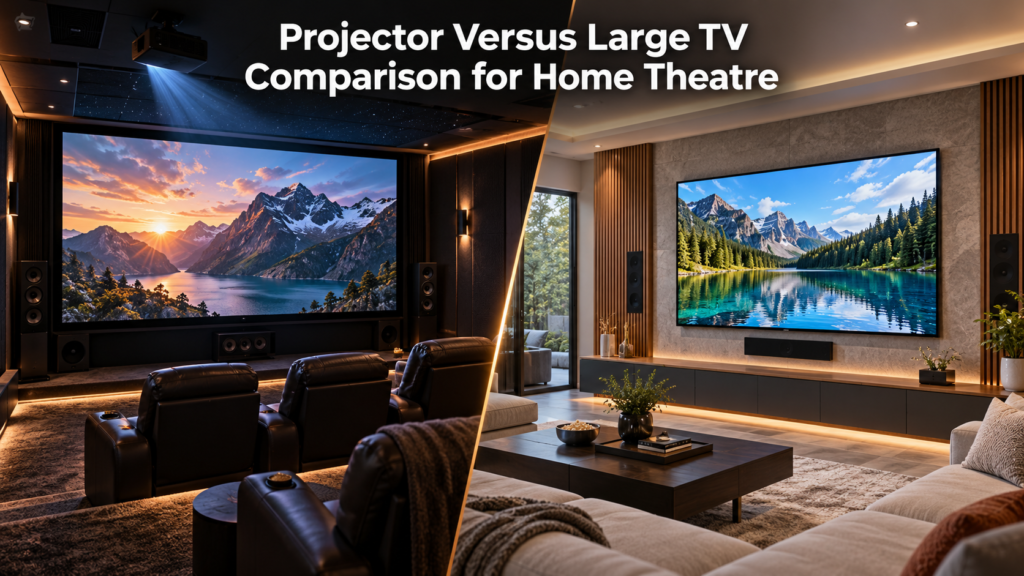
This comes up in almost every consultation once room size crosses a certain point: should you go big with a projector, or spend that budget on the largest TV that’ll fit the wall? Neither one is universally better, the right answer depends on your room’s ambient light, your budget at the screen size you actually want, and what you’ll mostly be watching. Here’s the honest breakdown.
Projector vs Large TV: Quick Comparison
| Factor | Projector | Large TV |
|---|---|---|
| Cost at 100″+ screen size | Wins clearly, screen cost barely rises with size | Expensive to prohibitive above 85″ |
| Brightness in ambient light | Needs a dark or light-controlled room | Wins clearly, stays watchable in daylight |
| HDR performance | Limited, can’t match TV peak brightness | Wins clearly on modern sets |
| Black levels / contrast | Good in a dark room, limited by reflected light | Wins, especially OLED with per-pixel dimming |
| Setup complexity | Requires mount, screen, wiring, room prep | Plug-and-play |
| Gaming (input lag) | Generally higher lag | Wins for competitive gaming |
| Screen size available | Effectively unlimited (100″–150″+) | Capped by what’s manufactured and affordable |
Cost Per Inch: Where Projectors Win Decisively
This is the single biggest factor in most decisions. A quality 4K projector and screen delivering a 120-inch image typically costs less in Hyderabad than a large flagship TV a fraction of that size. Screen cost barely increases between a 100-inch and 150-inch projection screen, while TV prices climb steeply as panels get larger, an 85-inch premium TV can cost several times a comparable projector setup, and TVs above 100 inches are still rare and extremely expensive where available at all. If “as big as possible” is the goal and budget matters, a projector wins this comparison clearly.
Brightness and Ambient Light: Where TVs Win Decisively
A modern flagship TV is a self-emitting panel driving its own pixels, capable of far higher brightness than a projected image can achieve. A projector’s lumens are reflected off a screen rather than emitted directly, so even a bright 3,000-lumen projector doesn’t compare to a TV’s output in a room with any real ambient light. The practical result: TVs dominate bright living rooms and daytime viewing, while projectors need a dark or properly light-controlled room, ideally with an ambient-light-rejecting (ALR) screen, to perform anywhere close to their potential.
HDR and Picture Quality
This is where TVs have a genuine, hard-to-close advantage. HDR content is mastered assuming high peak brightness, well beyond what a reflected projected image can reach, and modern OLED and mini-LED TVs offer per-pixel or zone-level dimming that projectors simply can’t match with a single light source. In a fully dark, properly designed room, a good projector still delivers a genuinely cinematic image, but if HDR performance and absolute picture accuracy are the priority over screen size, a TV wins this category.
Room Requirements and Setup
A TV is close to plug-and-play: mount it, connect your sources, done. A projector setup is a genuine installation project, throw distance calculation, mounting (ceiling or shelf), screen selection and installation, and often room modifications like blackout curtains or ALR screen material to control ambient light. This isn’t a reason to avoid a projector, our TV & projector mounting service handles exactly this, but it’s a real difference in complexity and upfront planning compared to hanging a TV on the wall.
Gaming and Input Lag
If competitive gaming is a priority, TVs generally have the edge, most modern gaming-focused TVs offer input lag low enough for fast-paced titles, while projectors, particularly budget and mid-range models, often introduce more processing delay. If gaming is occasional rather than competitive, this matters far less, but it’s worth knowing before committing to a projector-only setup if low input lag is genuinely important to you.
Longevity and Maintenance
TVs, particularly OLED models, carry some risk of burn-in with static content displayed for long periods, gaming HUDs, news tickers, and similar. Projectors have no burn-in risk since there’s no fixed pixel grid holding an image. On the maintenance side, lamp-based projectors need periodic bulb replacement over their lifespan, while laser projectors (increasingly standard in mid-range and above) run 20,000+ hours with minimal degradation and no bulb changes, worth checking which light source type you’re buying, since it affects long-term running cost.
Which Should You Choose?
Choose a Projector If:
- You want a screen size of 100 inches or larger without a very large budget
- You have a dedicated room, or can control ambient light with curtains or blinds
- Cinematic scale matters more to you than peak HDR brightness
- You want the option of an even bigger image later without replacing the whole display
Choose a Large TV If:
- Your room gets meaningful daylight and you’re not willing to control it
- HDR performance and picture accuracy matter more to you than absolute screen size
- You want plug-and-play simplicity without a dedicated installation project
- Gaming with low input lag is a priority
Many of our clients end up with a projector specifically because their room can be properly light-controlled, if you’re unsure whether your space qualifies, that’s exactly what a free consultation is for. For a full walkthrough of projector selection specifically, see our 4K Projector Buying Guide, and for a complete room build including screen and seating, our Best Home Theatre Setup for a 10×12 Room guide.
Frequently Asked Questions
Is a projector cheaper than a large TV?
At screen sizes above roughly 85-100 inches, yes, decisively. Below that size, pricing is closer, and a TV often wins on convenience even if the projector is competitive on cost.
Can a projector look good in a room with some daylight?
To a degree, with an ambient-light-rejecting (ALR) screen and a bright projector, but it will never match a TV’s performance in genuinely bright conditions. Full light control gives the best projector performance.
Do projectors have worse picture quality than TVs?
Not necessarily in a properly dark, well-designed room, but TVs generally win on HDR brightness and contrast regardless of room conditions, since a self-emitting panel isn’t limited by reflected light the way a projector is.
Which is better for gaming, a projector or a TV?
TVs generally have lower input lag and are the safer choice for competitive gaming. For casual or story-focused gaming, a good projector is still perfectly enjoyable.