
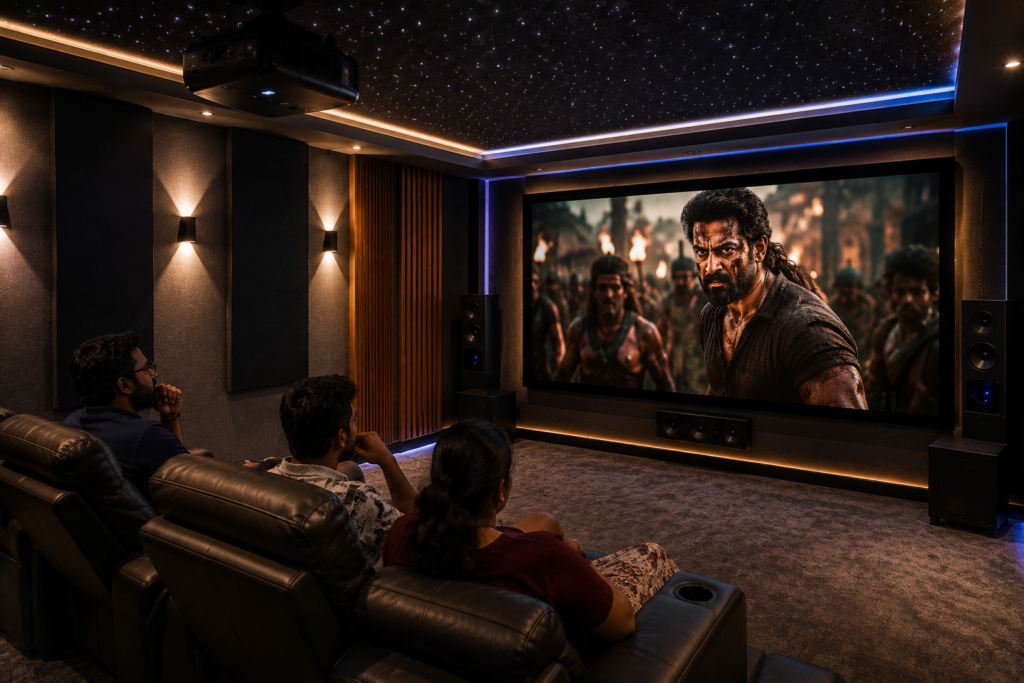
A private home cinema is a different brief from a living-room theatre upgrade, it’s a dedicated room, designed from the ground up around picture, sound, seating, and atmosphere, with nothing else competing for the space. As home cinema installers based in Hyderabad, this is the project type we’re asked about most by clients building or renovating a home with a spare room, basement, or dedicated floor to give over entirely to film and sound. Here’s exactly what a proper home cinema installation involves, room by room, decision by decision.
Private Cinema Rooms: What Makes Them Different
A private cinema room isn’t a living room with a bigger screen, it’s a space engineered specifically for controlled light, controlled sound, and a fixed, optimised seating position. That control is what separates a genuine home cinema from a media room: no windows fighting the projector, no shared-space compromises on speaker placement, and acoustic treatment sized to the room rather than squeezed in around furniture. Most of our private cinema installation projects start with a spare room, basement, or an entire floor set aside specifically for this purpose.
Home Cinema Design Hyderabad
Every project starts with design, not equipment selection. Home cinema design means mapping screen position, throw distance, speaker layout, seating position, lighting, and acoustic treatment together as one coherent plan, based on a free, on-site consultation where we measure your actual room rather than working from photos or a floor plan alone. This is also where budget gets scoped realistically against what the room can support, so equipment choices later in the process are informed decisions, not guesses.
Projector and Screen
In a fully light-controlled cinema room, you can prioritise contrast and colour accuracy over raw brightness, unlike a living-room installation that has to fight ambient light. We typically recommend native or high-quality pixel-shifting 4K projectors in the 2,000–2,500 ANSI lumen range for these rooms, paired with an acoustically transparent screen sized to your throw distance, which lets the centre channel sit directly behind the screen at the correct ear-level position instead of above or below it.
Cinema Seating
Dedicated recliner seating, individual or in rows, with cup holders, storage consoles, and power recline, is the standard for a genuine private cinema room, distinct from a sectional sofa in a multi-purpose media room. For rooms with two or more rows, we build a proper riser, typically 12–14 inches for the back row, so sightlines stay clear rather than having the front row block the screen. Seating position also has to align with your Dolby Atmos speaker layout, since height and surround speakers are calibrated to a specific listening position.
Acoustic Treatment
Bare walls in a dedicated cinema room create harsh reflections and boomy, uneven bass regardless of how good the speakers are. We install absorption panels at first-reflection points on the side walls, treat the rear wall to control slap echo, and place bass traps in the corners where low-frequency buildup is worst, generally covering 20–30% of wall surface area for the right balance between clarity and a natural-sounding room. See our dedicated acoustic treatment page for the full breakdown of panel types, bass traps, and cost factors.
Lighting
Cinema room lighting has two jobs: staying completely out of the way during a film, and setting the mood before and after. We typically install dimmable, warm-toned LED strip lighting along the ceiling perimeter or behind acoustic panels, tied into a single automation scene so the room dims automatically when the film starts, and layer in low-level step or aisle lighting for safe movement during screenings without any glare hitting the screen.
Soundproofing
Soundproofing and acoustic treatment are often confused, but they solve different problems. Acoustic treatment improves how sound behaves inside your cinema room; soundproofing stops sound from travelling to the rest of the house. For a dedicated cinema room, especially one with a serious subwoofer, soundproofing typically means mass-loaded vinyl or resilient isolation on shared walls, sealed door gaps, and sometimes a floating floor, genuinely effective but a bigger, more construction-intensive undertaking than acoustic treatment alone, and worth planning for early if late-night viewing near bedrooms is a concern.
Dolby Atmos
A dedicated cinema room is exactly the setting Dolby Atmos was designed for. Single-row rooms typically suit a 5.1.2 layout; larger rooms with multiple seating rows can support a full 7.1.4 build, with four height speakers and extended rear surrounds for genuine front-to-back movement in overhead effects. We calculate height-speaker placement and angle against your specific seating position so the immersive effect is actually audible, not just technically installed.
AV Automation
In a dedicated cinema room, automation usually means a single “Movie Night” scene: lights dim, curtains close if fitted, the AV receiver switches to the correct input, and the projector powers on, all from one button or app tap. For serious cinema builds we generally recommend a proper hub-based system like Crestron rather than basic consumer smart-home devices, since it handles coordinated, multi-device scenes far more reliably than piecing together separate smart plugs and bulbs.
Custom Interiors
Beyond the technical build, a private cinema room is also an interior design project, acoustic panels finished in fabric that matches your material palette, LED-lit ceiling details, starfield ceilings, feature walls, and bar or lounge areas for larger rooms. We work these finishes into the acoustic and lighting plan from the design stage rather than treating them as decoration applied afterward, so the room performs and looks intentional, not like equipment installed into a finished space.
Our Home Cinema Installation Process
- Free consultation and room assessment. We measure your space, check ceiling type and height, and understand how you plan to use the room.
- Design. Screen, speaker layout, seating, lighting, and acoustic treatment are planned together as one coherent scheme, not decided item by item.
- Itemised quote. You receive a transparent breakdown of costs before any work begins, no hidden line items added later.
- Construction and wiring. Cable runs, acoustic panel mounting, riser construction (if applicable), and any soundproofing work are completed.
- Equipment installation. Projector, screen, speakers, AV receiver, and automation hardware are installed and connected.
- Calibration. Audio and picture are calibrated to your room’s specific acoustics and screen material.
- Handover. A full walkthrough of your system, with training on the automation scenes and remote before we consider the project complete.
Home Cinema Installation Cost in Hyderabad (Indicative Budget)
| Tier | Typical Budget | What’s Included |
|---|---|---|
| Entry Cinema Room | ₹6L – ₹9L | 5.1.2 Dolby Atmos, 4K projector, acoustic treatment, dedicated recliner seating |
| Mid-Range Private Cinema | ₹10L – ₹16L | 7.1.4 Atmos, premium seating with riser, soundproofing, automation, custom lighting |
| Premium Cinema Build | ₹18L+ | Reference-grade equipment, full soundproofing, custom interiors, Crestron automation |
These are indicative budgets, not fixed market prices. Final pricing depends on room size, equipment selection, acoustic work, wiring, and installation requirements, along with any civil work needed for risers or soundproofing. We provide an exact, itemised quote after your free consultation, so you know precisely what you’re paying for before committing.
Frequently Asked Questions
What’s the difference between a home theatre and a home cinema?
In practice the terms overlap heavily, but “home cinema” more often refers to a fully dedicated room built specifically for film and sound, while “home theatre” can describe anything from a living-room upgrade to a dedicated room. Our process is the same either way, the terminology just reflects how dedicated the space is.
Do I need soundproofing, or is acoustic treatment enough?
Depends on your goal. Acoustic treatment improves sound quality inside the room and is essential for every build. Soundproofing stops sound from reaching the rest of the house, only necessary if noise disturbance to other rooms or neighbours is a real concern, and it’s a bigger, more expensive undertaking than acoustic treatment alone.
How long does a full home cinema installation take?
A dedicated cinema room, including construction, acoustic treatment, and equipment installation, typically takes 3–6 weeks from design sign-off to handover, depending on civil work and any soundproofing involved.
Can you build a private cinema room in an apartment?
Yes, within the constraints of shared walls, building regulations on drilling, and false ceilings common across Hyderabad’s high-rise developments. Full soundproofing is more limited in a rented apartment, but acoustic treatment, seating, and a proper Atmos build are all achievable.
Explore More
- Home Theatre Installation in Hyderabad — full installation service overview
- Home Theatre Interior Design — acoustic panels, lighting, seating & more
- Our Full List of Installation Services