
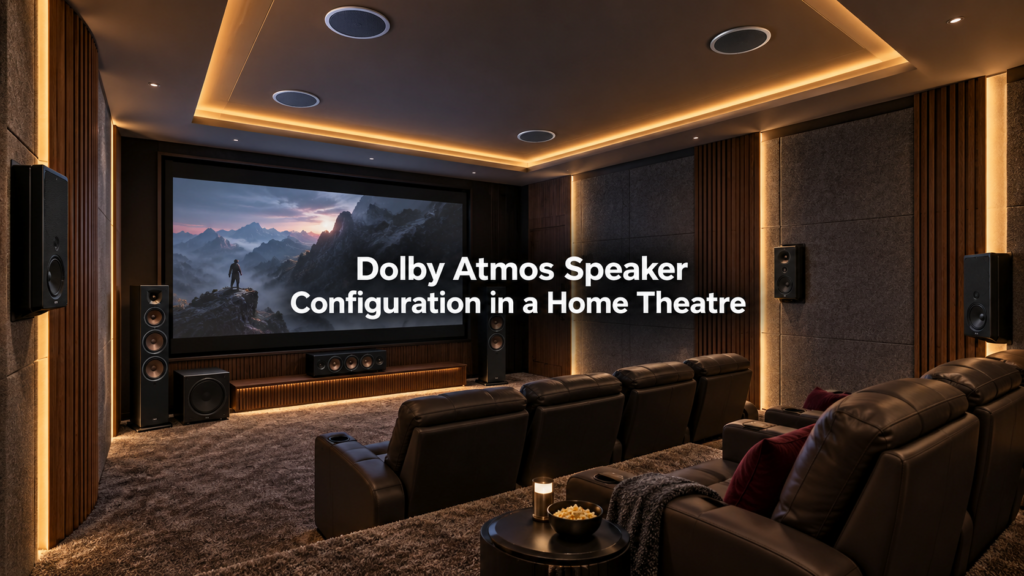
The short answer: most home Dolby Atmos systems use 7 to 11 speakers total, including the subwoofer, depending on which configuration you choose. The minimum to get genuine Atmos overhead sound is a 5.1.2 system, 8 speakers including the subwoofer. Here’s the exact breakdown by configuration, what actually changes as you add speakers, and how to decide what your room needs.
What the Numbers in a Dolby Atmos Configuration Mean
Every Dolby Atmos setup is described in an X.Y.Z format, and each number is a real, physical speaker count:
- X = ear-level speakers (front left, centre, front right, and surrounds)
- Y = subwoofers
- Z = height or overhead speakers, the defining feature of Atmos
So 5.1.2 means 5 ear-level speakers, 1 subwoofer, 2 height speakers, 8 speakers in total. 7.1.4 means 7 ear-level speakers, 1 subwoofer, 4 height speakers, 12 speakers in total.
Dolby Atmos Speaker Count by Configuration
| Configuration | Ear-Level Speakers | Height Speakers | Total Speakers (incl. sub) | AVR Channels Needed |
|---|---|---|---|---|
| 5.1.2 (minimum for true Atmos) | 5 | 2 | 8 | 7-channel |
| 5.1.4 | 5 | 4 | 10 | 9-channel |
| 7.1.2 | 7 | 2 | 10 | 9-channel |
| 7.1.4 (most common recommended setup) | 7 | 4 | 12 | 11-channel |
| 9.1.6 (premium dedicated cinema rooms) | 9 | 6 | 16 | 15-channel or 11-channel + external amp |
What’s the Minimum Number of Speakers for Real Dolby Atmos?
5.1.2, eight speakers total, is the smallest configuration Dolby classifies as genuine Atmos. Dolby itself labels two-height-speaker setups (5.1.2, 7.1.2) as “essential” and four-height-speaker setups (5.1.4, 7.1.4) as “premium,” explicitly recommending four height speakers for the best overhead effect at every seating position, not just the exact centre seat. Below 5.1.2, without dedicated height channels, you’re not hearing true Atmos even if your receiver supports the format, you need the physical height speakers for the overhead layer to actually exist.
How Many Speakers Do You Actually Need?
More speakers generally means more precise sound placement, but the right number depends on your specific room, not a universal “more is better” rule:
- Single row of seating, room up to roughly 250-300 sq ft: 5.1.2 is genuinely enough. The overhead effect is clearly audible with just two height speakers in a room this size.
- Single row, larger room, or you want the strongest possible overhead effect: 5.1.4 adds a second height speaker pair for more precise front-to-back overhead movement.
- Multiple seating rows, or you prioritise horizontal surround coverage over height precision: 7.1.2 adds rear surrounds, useful for every kind of content, not just Atmos scenes specifically.
- Dedicated cinema room, multiple rows, reference-grade build: 7.1.4 is the most common recommendation for a serious dedicated home theatre, combining full horizontal surround with four height speakers.
- Large dedicated cinema rooms with the budget to match: 9.1.6 adds front wide speakers and a third height pair, genuinely only worth it in rooms large enough to give every added speaker real physical separation.
For a deeper comparison specifically between the two most common choices, see our guide: 5.1.2 vs 7.1.4: Which Dolby Atmos Layout Is Right For You?
AV Receiver Channel Requirements
Your speaker count determines how many amplifier channels your AV receiver needs, and this is a real budget factor, not just a speaker-shopping decision. A 5.1.2 system needs a 7-channel receiver; 7.1.4 needs 11 channels, either an 11-channel receiver directly, or a 9-channel receiver paired with a 2-channel external amplifier for the height speakers. If you think you might upgrade your configuration later, buying a receiver with more channels than you need today is cheaper in the long run than replacing the whole receiver when you add speakers.
Can You Get Dolby Atmos With Fewer Speakers?
Yes, through virtualisation, soundbars and some AV receivers can process Atmos content and simulate an overhead effect using psychoacoustic processing rather than physical height speakers. This genuinely works to a degree, but it’s not equivalent to real height speakers, the overhead effect is less precise and less convincing, particularly outside the exact centre listening position. If you’re aiming for genuine Dolby Atmos performance rather than an approximation, physical height speakers, starting at 5.1.2, are the real answer to “how many speakers do I need.”
Our Recommendation for Most Hyderabad Homes
For the majority of installations we do, media room conversions and single-row dedicated rooms, 5.1.2 delivers a genuinely immersive result without over-specifying a room that doesn’t need it. We size every Atmos layer to the actual room during a free consultation, checking ceiling height and seating position before recommending a configuration, rather than defaulting to the largest system available. See our full home theatre installation services for how Dolby Atmos installation fits into a complete build.
Frequently Asked Questions
What is the minimum number of speakers for Dolby Atmos?
5.1.2, eight speakers total including the subwoofer, is the smallest configuration that delivers genuine Dolby Atmos overhead sound.
Is 7.1.4 better than 5.1.2?
Not universally, it depends on your room. 7.1.4 adds rear surrounds and two extra height speakers, which genuinely helps in larger rooms with multiple seating rows, but can be more speakers than a smaller single-row room can meaningfully use.
Do I need a subwoofer for Dolby Atmos?
Yes, the subwoofer (the “1” in every X.1.Z configuration) handles low-frequency effects and is part of every standard Atmos configuration, not an optional add-on.
Can a soundbar deliver real Dolby Atmos?
Soundbars can process and play Atmos content, but most use virtualisation to simulate height rather than physical height speakers, which sounds noticeably less precise than a true speaker-based Atmos system.
How many speakers do I need if I only have a small room?
5.1.2 is well suited to smaller and medium rooms, roughly up to 250-300 sq ft with single-row seating, and is close to the minimum room size Dolby itself designs the format around.