
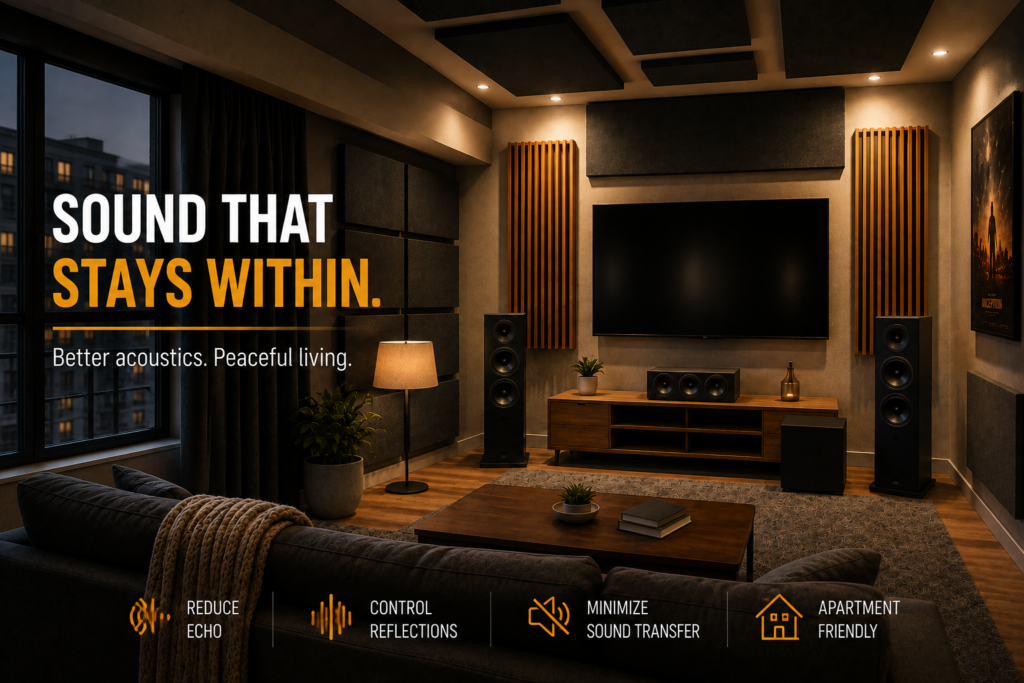
Most apartment dwellers assume a good home theatre is off the table unless you own a house with a spare room to gut. It isn’t. What actually determines whether your media room sounds sharp or muddy has less to do with square footage and more to do with getting one specific thing right: understanding the difference between soundproofing and acoustic treatment, and applying the right one to the right problem. Get that wrong and you’ll spend money on foam panels that do nothing about your neighbours, or spend on wall construction when all you needed was a few well-placed panels. Here’s what actually works.
Two Different Problems, Often Confused
These two terms get used interchangeably, and that confusion is where most apartment acoustic budgets get wasted.
- Soundproofing (isolation) stops sound from travelling between spaces, keeping your movie audio from bothering the neighbours, and keeping their noise out of your room. It works through mass, sealing, and decoupling: dense materials, airtight gaps, and structurally separating surfaces so vibration can’t easily pass through.
- Acoustic treatment (absorption) improves how sound behaves inside your room, reducing echo, taming reflections off hard walls, and cleaning up dialogue clarity. It works through porous, absorptive materials like foam or fabric-wrapped panels.
Sticking acoustic panels on your walls will make your movies sound noticeably better. It will not stop your neighbours from hearing your subwoofer. These are genuinely separate problems with separate solutions, and most apartment home theatre budgets are better spent almost entirely on the first one, acoustic treatment, because it’s what makes the room sound like a cinema instead of a living room with a big screen in it.
What Acoustic Treatment Can Fix
In a typical Hyderabad apartment room, hard walls, tile or wood flooring, minimal soft furnishing, sound bounces aggressively off every hard surface. That’s what causes:
- Dialogue that sounds muddy or hard to follow, especially during action scenes with a lot of background noise
- A harsh, “boxy” quality to music and effects
- Boomy, uneven bass that sounds different depending on where you sit
- An echo or “slap” you can hear if you clap your hands in the room
All of this is fixable with acoustic treatment, and it’s genuinely one of the highest-return upgrades in any home theatre installation in Hyderabad project, often a bigger audible improvement than upgrading the speakers themselves.
What Acoustic Treatment Can’t Fix
If your actual complaint is “I don’t want to disturb my neighbours” or “I can hear the TV from next door,” that’s a soundproofing problem, and foam panels won’t solve it. Low-frequency bass in particular travels through concrete and shared walls with very little resistance, this is physics, not a product quality issue, and it’s the single most common apartment home theatre frustration. Real soundproofing (mass-loaded vinyl, resilient isolation clips, sealed gaps, floating floors) is a construction-level intervention, considerably more expensive and disruptive than acoustic treatment, and usually only worth pursuing if you own the apartment and are planning a proper renovation.
For most renters and apartment owners, the practical answer isn’t full soundproofing, it’s acoustic treatment for sound quality, combined with a few reasonable habits around bass and volume (more on that below).
Looking for a customised solution? Explore our professional acoustic treatment services in Hyderabad.
What Actually Works: Practical Apartment Fixes
1. Absorption Panels at First Reflection Points
The single highest-impact placement: the points on your side walls where a mirror held flush against the wall would show you your speakers, reflected back at your seated position. Treating just these points does more for clarity than randomly covering walls.
2. Rear Wall Treatment
The wall behind your seating position is usually the second-biggest offender for “slap echo”, a short, sharp reflection that muddies dialogue. A panel or heavy curtain here makes a noticeable difference.
3. Bass Traps in the Corners
Low frequencies build up disproportionately in room corners. Corner bass traps (denser foam or fabric-wrapped absorbers) even out boomy, uneven bass far more effectively than trying to fix it with equalisation alone.
4. Rugs and Soft Furnishing
Hard flooring is a major reflective surface most people ignore. A thick rug under the seating area, along with curtains over any windows, meaningfully reduces overall reflections without a single panel.
5. How Much Coverage You Actually Need
You don’t need to cover every wall. The sweet spot most acousticians target is roughly 20–30% of wall surface area, enough to control reflections and echo without making the room feel acoustically “dead” or unnaturally flat. Over-treating a room is a real mistake; a small amount of natural reflection keeps a room sounding lively rather than muffled.
Dealing With Bass Without Upsetting the Neighbours
Since bass is the hardest frequency range to contain in an apartment, a few practical, non-structural steps go a long way:
- Isolation pads or a decoupling platform under the subwoofer, reduces how much bass energy transfers directly into the floor and structure.
- Subwoofer placement away from shared walls, a few feet of distance from a wall you share with a neighbour measurably reduces transmitted bass.
- Bass management in your AV receiver proper crossover and level calibration (ideally via the receiver’s automatic room correction) prevents unnecessary excess bass energy in the first place.
- Reasonable volume limits for late viewing, the simplest fix of all, and worth setting as a habit rather than relying purely on equipment.
Renter-Friendly vs. Permanent Options
If you’re renting, look for acoustic panels that mount with removable adhesive strips or lean against the wall in freestanding frames rather than anything requiring drilling. Heavy curtains, thick rugs, and bookshelves filled with books (a surprisingly effective, low-cost diffuser) are entirely reversible and genuinely effective. If you own the apartment and are doing a proper fit-out, fixed wall panels, ceiling treatment, and a purpose-built acoustic layout as part of a full home cinema design in Hyderabad project will always outperform temporary solutions, but the renter-friendly version is a legitimate, meaningful upgrade on its own.
What This Typically Costs
For a standard apartment media room in Hyderabad, a properly planned acoustic treatment package, first-reflection panels, rear wall treatment, and corner bass traps, usually falls in the ₹40,000–₹90,000 range depending on room size and finish quality, broadly consistent with what we outlined in our 10×12 room home theatre budget breakdown. It’s a relatively small line item next to the speakers and projector, and consistently one of the highest-ROI parts of the whole build.
Frequently Asked Questions
Will acoustic foam stop my neighbours from hearing my movies?
No. Acoustic foam and panels absorb sound inside your room to improve clarity, they don’t block sound transmission through walls. If neighbour noise is your real concern, that’s a soundproofing problem, which requires mass and sealing, not absorptive panels.
Do I need to treat the entire room?
No, covering roughly 20–30% of wall surface area, focused on first-reflection points, the rear wall, and corners, is typically enough. Over-treating a room can make it sound unnaturally dead.
Can I do acoustic treatment without drilling into rental walls?
Yes. Removable adhesive-mounted panels, freestanding acoustic frames, heavy curtains, and thick rugs are all effective, fully reversible options for renters.
What’s the single most important fix for a muddy-sounding room?
Treating the first-reflection points on your side walls, where sound from your speakers first bounces back toward your seat. It’s usually the highest-impact, lowest-cost fix available.