
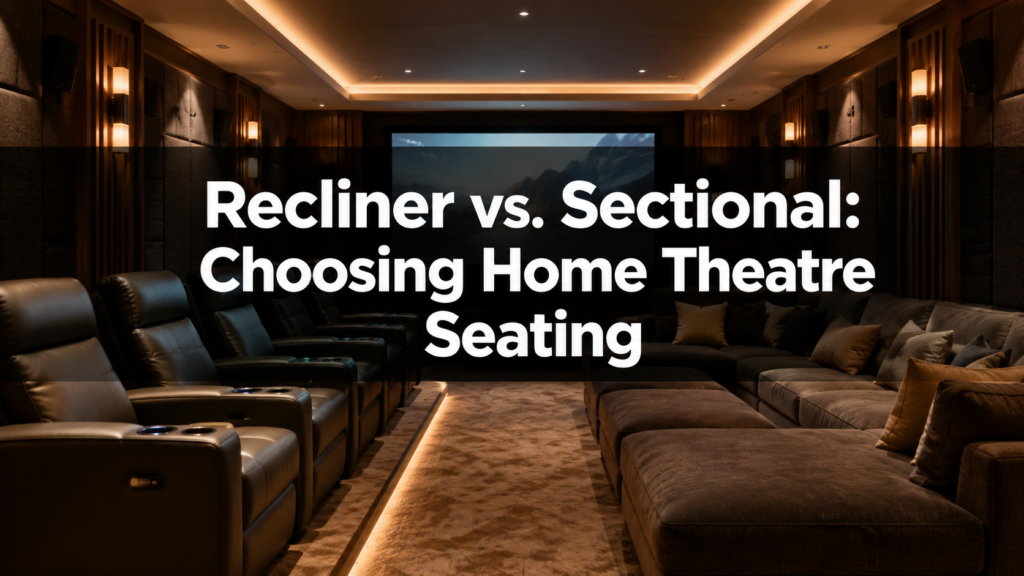
Seating is the part of a home theatre project people research least and regret most. You can spend weeks agonising over projector brightness and Dolby Atmos speaker counts, and still end up with a room that’s uncomfortable to actually sit in for two hours. Choosing the right home theatre seating for your Hyderabad home comes down to one honest question: is this room a dedicated cinema, or a multi-purpose space that also needs to work as a living room? That single answer decides almost everything else.
The Real Difference: Dedicated Use vs. Multi-Purpose Rooms
Regular sofas and sectionals are built for varied use, you sit upright, you sprawl sideways, you nap, you eat dinner off your lap. Dedicated theatre recliners are built for one thing: long, immersive, upright-to-reclined viewing sessions, with the body support to make two hours in one position genuinely comfortable. Neither is “better” in the abstract. The right choice depends entirely on how the room is actually going to be used.
Dedicated Recliners: Best For a True Cinema Room
Individual theatre recliners bolt together in rows, two-seat, three-seat, or four-seat configurations, often with a center console between each seat for cup holders and storage. Most premium options today include power recline, power headrests, and USB charging.
Strengths:
- Purpose-built body support for long viewing sessions
- Individual cup holders, armrest storage, and often LED ambient lighting
- A uniform, “designed” look that reads as a genuine cinema room rather than a living room with a big screen
- Wall-hugger mechanisms are available for smaller rooms, they slide forward as they recline, needing only 3–5 inches of rear clearance instead of the 12–18 inches a standard recliner needs
Trade-offs:
- Less flexible for casual, multi-purpose use, theatre recliners are built for facing-the-screen viewing, not lounging sideways or hosting a large group
- Higher cost per seat than an equivalent sectional
- Every power-recline seat needs its own power outlet nearby, which needs planning before installation, not after
Sectionals: Best For Multi-Purpose Rooms
A sectional works well when the room genuinely doubles as a living space, family TV time, gaming, guests over for a casual watch, not just formal movie nights. L-shaped or U-shaped configurations can comfortably seat more people per square foot than a straight row of individual recliners, and they blend more naturally into a home that isn’t a fully dedicated cinema room.
Strengths:
- More flexible seating positions and group sizes
- Better suited to a room with mixed daily use, not just movie nights
- Generally lower cost for the same seating capacity
Trade-offs:
- Lacks dedicated theatre features, individual cup holders, storage consoles, synchronized power recline
- Deep, plush cushions aren’t optimised for the more upright, screen-focused posture theatre viewing rewards, if you go this route, look for a sectional with firmer back support rather than the deepest, softest option available
- Harder to get a uniform “cinema” look and feel
How Seating Affects Your Dolby Atmos Sweet Spot
This is the connection most seating guides miss entirely: where you sit isn’t just about comfort, it directly affects how your sound system performs. If you’ve already worked out your speaker layout, see our 5.1.2 vs 7.1.4 comparison if you haven’t, your seating position needs to sit inside the “sweet spot” those height and surround speakers are aimed at. A sectional’s flexible, sprawl-anywhere seating positions work against this: if people are seated off-angle or too close to a side wall, the carefully calculated overhead and surround imaging simply doesn’t reach them the way it’s designed to. Fixed-row theatre recliners, positioned deliberately during installation, keep everyone inside that sweet spot, one more reason dedicated seating pairs better with a serious Atmos build than a casual sectional does.
Sizing Seating to Your Room
| Room Size | Recommended Layout |
|---|---|
| Small (under 150 sq ft, e.g. a 10×12 room) | Single row of 2–4 seats. Skip the riser, one good row beats two cramped ones. |
| Medium (150–250 sq ft) | Single row of 4–6 seats, or two rows if depth allows, with at least 8 inches of riser height for the back row. |
| Large (250+ sq ft) | Two or three rows with proper risers, or a mixed layout, dedicated seats up front, sectional-style seating further back. |
If you’re working with a 10×12 room specifically, our full setup and budget guide covers exactly this seating tier alongside the rest of the room’s build-out.
Two-Row Rooms Need a Proper Riser, Not Just Extra Floor Space
If your room is large enough for two rows, a flat floor genuinely doesn’t work: the front row’s heads block the lower portion of the screen for anyone sitting behind them. A well-built riser, typically 12–14 inches for the back row, turns the room into proper stadium-style seating so the second row has a clear sightline. Each row also needs roughly 6–7 feet of depth to allow for a fully reclined seat plus walk-through space behind it. This is exactly the kind of measurement that should happen during a proper site visit as part of your home theatre installation in Hyderabad project, not guessed at after the seats have already arrived.
Materials: What Actually Holds Up in Hyderabad’s Climate
This is one consideration most seating guides, written for drier climates, don’t cover, and it matters more here than people expect. Hyderabad’s humidity swings meaningfully across the year, and fabric upholstery genuinely performs worse over time in high-humidity conditions: it holds moisture, is harder to clean, and is more prone to odour retention. Leather or high-quality leatherette is the more practical choice for most Hyderabad homes, it wipes clean easily, handles humidity far better, and holds up to years of regular use without the maintenance fabric demands. It’s worth prioritising over fabric even if the fabric option looks marginally nicer in a showroom.
What This Typically Costs
For dedicated theatre recliners in Hyderabad, budget roughly ₹40,000–₹90,000 per seat for a quality power-recline unit with the features described above (higher for premium leather and additional consoles/lighting). A comparable sectional covering the same seating capacity typically runs ₹1.2L–₹2.5L total, depending on size and material, often less per seat than dedicated recliners, but without the theatre-specific features. Neither is the “cheap” or “expensive” option in absolute terms; the right spend depends on which one actually matches how you’ll use the room.
Frequently Asked Questions
Is a sectional ever the right choice for a serious home theatre?
Yes, if the room genuinely doubles as a living space for daily use, not just movie nights. For a fully dedicated cinema room, especially one built around a specific Dolby Atmos speaker layout, dedicated recliners are almost always the better fit.
Do I need a riser for a single row of seating?
No. Risers only matter once you have two or more rows and need to preserve sightlines for the back row. A single row, positioned correctly, doesn’t need one.
How much rear clearance does a recliner actually need?
Standard recliners typically need 12–18 inches of clearance behind the seat when fully reclined. Wall-hugger recliners, which slide forward as they recline, need only 3–5 inches, a meaningful difference in smaller rooms or apartments.
Does seating position really affect Dolby Atmos sound quality?
Yes. Height and surround speakers are calibrated to a specific listening position. Seating positioned outside that zone, common with flexible sectional layouts, won’t receive the full overhead and surround effect the system is designed to deliver.
Leather or fabric for a Hyderabad home theatre?
Leather or good-quality leatherette generally holds up better in Hyderabad’s humidity, cleans more easily, and needs less long-term maintenance than fabric upholstery.