
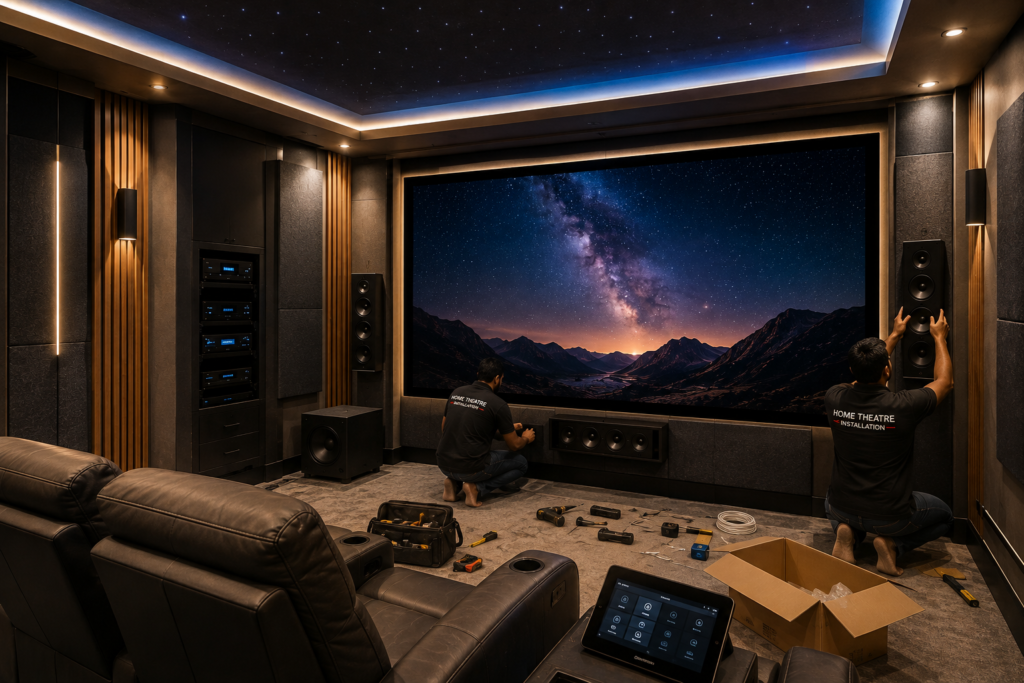
Looking for home theatre installation services or home theater installation services in Hyderabad and want to know exactly what’s involved before you book anything? A real installation is really eleven smaller jobs done well and done in the right order, get any one of them wrong, poor speaker placement, untreated acoustics, a rushed calibration, and the whole system underperforms no matter how much you spent on equipment. This page breaks down every individual service, projector installation, speaker installation, AV installation, acoustic treatment, and more, so you know exactly what you’re paying for. For pricing, budget tiers, and why to choose us specifically, see our main Home Theatre Installation in Hyderabad page.
Custom Home Theatre Installation in Hyderabad
No two rooms we’ve installed in Hyderabad have been identical, and “custom” isn’t a marketing word here, it’s a practical necessity. An apartment in Kokapet with a low false ceiling needs a different projector and speaker strategy than an independent house in Jubilee Hills with an open-plan living room. A dedicated basement cinema room in Banjara Hills can support full 7.1.4 Atmos and tiered seating; a spare bedroom conversion in Gachibowli usually calls for a tighter 5.1.2 layout and more careful acoustic treatment to compensate for the smaller footprint.
Every project starts with a free, on-site consultation for exactly this reason: measuring your room’s throw distance, checking ceiling type and ceiling height, assessing existing wiring, and understanding how you’ll actually use the space before we recommend anything. What follows is the full list of services that go into building your system around those specifics, not a generic package.
Our Home Theatre Installation Services
Home Theatre Design
Before any equipment is chosen, we design the room: screen or projector placement, speaker layout, seating position, cable routing, and lighting, all planned together rather than decided piecemeal as items get installed. This is where throw distance, ceiling height, and room acoustics get mapped against your budget and the equipment tiers that make sense for your space, so every later step (projector, screen, speakers, wiring) is executed against a single coherent plan instead of a series of separate purchases.
Projector Installation
Projector installation covers more than mounting a bracket to the ceiling. We calculate exact throw distance against your chosen screen size, select the correct lens shift or ceiling offset to avoid keystone distortion, and route power and HDMI through concealed conduit rather than surface-run cable. For rooms where a ceiling mount isn’t practical, apartments with shared ceilings, low false ceilings, or rental restrictions, we also install ultra-short-throw projectors positioned on a credenza just inches from the screen.
Screen Installation
Screen size and material are matched to your room’s ambient light and throw distance, not chosen off a generic size chart. In rooms with any meaningful ambient light, we typically recommend an ambient-light-rejecting (ALR) screen for better contrast; where a proper speaker system is planned, an acoustically transparent screen lets the centre channel sit directly behind the screen at ear level, the correct position, instead of awkwardly above or below it.
Dolby Atmos Installation
Dolby Atmos installation is sized to your room, not defaulted to the biggest configuration available. Most rooms in the 10×12 to 12×14 ft range are well served by a 5.1.2 layout, two height speakers plus a standard 5.1 bed; larger dedicated cinema rooms with multiple seating rows can support a full 7.1.4 build. We calculate exact height-speaker placement and angle relative to your primary seating position so the overhead effect is genuinely audible, not just technically present.
Surround Sound Installation
Beyond Atmos height channels, proper surround sound installation means correct placement of every speaker in the bed layer: centre channel at screen height, left and right mains angled toward the seating position, side and rear surrounds positioned for even coverage rather than wherever a wall happens to allow. Speaker positioning has as much impact on how a system sounds as the speakers themselves, which is why we treat placement as a calculated step, not an afterthought once the boxes arrive.
AV Receiver Installation
AV installation centres on your receiver, the hub every source and speaker connects through, and choosing the right one, matched to your channel count, power requirements, and current and future source devices, is easy to get wrong if it’s an afterthought. We install and configure the receiver as part of the same process as the speaker layout, ensuring channel assignments, HDMI routing, and eARC configuration (for lossless Atmos audio from modern TVs and streaming devices) are all set up correctly from day one.
Speaker Installation
In-wall, in-ceiling, or floor-standing, speaker installation includes running and concealing the cable, cutting and finishing any in-wall or in-ceiling mounts cleanly, and positioning each speaker at the calculated angle and height from your design phase. This is also where timbre matching matters: using speakers from a consistent product line so voices and effects sound seamless as they move between channels, rather than mismatched speakers that shift in tone as sound pans across the room.
Acoustic Treatment
Acoustic treatment is consistently the highest-impact, most commonly skipped part of a home theatre build. We install absorption panels at first-reflection points on the side walls, treat the rear wall to control slap echo, and place bass traps in corners where low-frequency buildup is worst, typically covering 20–30% of wall surface area rather than over-treating the room into an unnaturally dead-sounding space. For apartments, we also offer renter-friendly, removable panel options that don’t require permanent wall modifications. Visit our dedicated acoustic treatment in Hyderabad page for panel types, bass traps, diffusers, and cost factors in full detail.
Concealed Wiring
All speaker cable and HDMI runs are routed through walls, ceilings, or conduit wherever the room allows, rather than surface-mounted along skirting boards. Where a room is being built or renovated from scratch, we run this wiring before walls are closed up, including extra capacity for future upgrades like additional height speakers, since adding wiring later means reopening finished surfaces. For retrofits where opening walls isn’t an option, we use surface-mount cable concealment designed to blend into the room rather than stand out.
Home Automation
Home automation ties your theatre system into a single-remote or single-app experience, one button dims the lights, closes the curtains, and switches the AV receiver to the right input simultaneously, rather than juggling multiple remotes and switches. We install both wired systems (for new construction or renovation, where dedicated low-voltage cabling gives the most reliable long-term performance) and wireless systems (for apartment retrofits where opening walls isn’t practical), scoped to the room you’ll actually use daily.
Calibration
Calibration is the step that determines whether a correctly installed system actually performs to its potential. We calibrate audio to your room’s specific acoustics using the AV receiver’s room correction tools, adjusting levels and crossover points for your actual speaker positions rather than factory defaults, then calibrate picture settings for your specific screen material and ambient light conditions. This is typically the difference between a system that looks and sounds impressive in a showroom and one that performs correctly in your actual room.
Frequently Asked Questions
Do I need all eleven services, or can I choose specific ones?
Most clients need the full set for a new installation, but if you already have a projector, TV, or speakers you want to keep, we can scope a project around specific services, acoustic treatment and calibration alone, for example, rather than a complete build.
Which of these services matters most if I have to prioritise?
Speaker placement and acoustic treatment consistently deliver the biggest audible improvement relative to cost. A well-treated room with mid-range equipment will outperform a poorly treated room with premium equipment almost every time.
Can you add home automation to a system you didn’t originally install?
Yes, in most cases. Wireless automation systems can be added to an existing home theatre setup without opening walls, though a system installed alongside the original wiring will always be marginally more reliable long-term.
How do you decide between a 5.1.2 and 7.1.4 Dolby Atmos layout?
Primarily room size and seating rows. 5.1.2 suits single-row seating in rooms up to roughly 250–300 sq ft; 7.1.4 needs a larger room, generally 12×14 ft or more, to give the extra rear surrounds and height speakers enough physical separation to sound distinct.