
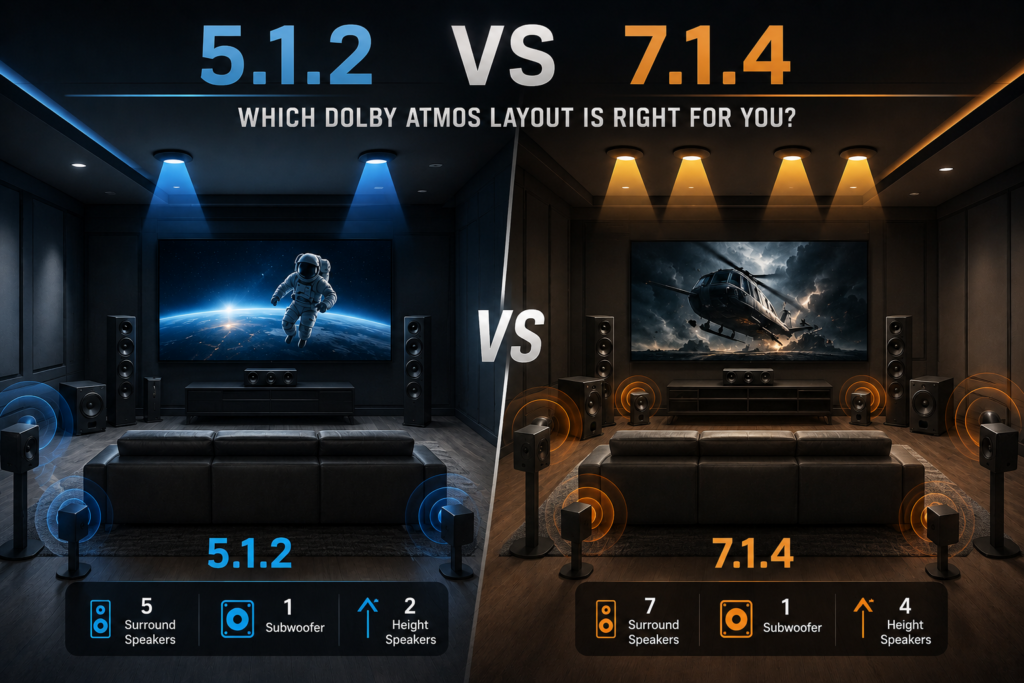
If you’ve started researching Dolby Atmos for your home, you’ve almost certainly run into these two numbers: 5.1.2 and 7.1.4. They’re the two most common Atmos configurations, and picking between them is one of the first real decisions in any Dolby Atmos installation in Hyderabad project. The honest answer is that neither one is “better” in the abstract, the right choice depends almost entirely on your room size, seating layout, and budget. Here’s how to actually decide.
What the Numbers Mean
Every Dolby Atmos configuration follows the same X.Y.Z format:
- X — Bed layer: the traditional ear-level speakers (left, centre, right, plus surrounds). This is your base 5.1 or 7.1 system.
- Y — Subwoofer(s): almost always shown as .1, though a second subwoofer (.2) is common in larger rooms for smoother bass.
- Z — Height layer: the overhead Atmos speakers, either in-ceiling or upward-firing modules, that create the sense of sound moving above you.
So 5.1.2 means 5 ear-level speakers, 1 subwoofer, and 2 height speakers. 7.1.4 means 7 ear-level speakers, 1 subwoofer, and 4 height speakers. Every extra digit is a real, physical speaker, extra wiring, and extra amplifier channels, which is why the jump from 5.1.2 to 7.1.4 is a bigger cost step than it might look on paper.
5.1.2: The Entry Point Into Real Atmos
A 5.1.2 system takes a standard 5.1 setup (left, centre, right, two surrounds, one subwoofer) and adds a single pair of ceiling-mounted or upward-firing height speakers positioned roughly above and slightly in front of the main seat. That’s it, and it’s genuinely enough to hear the difference Atmos makes. Rain, ambient sound design, and directional effects gain real vertical movement, even with just two height channels.
Best suited for:
- Rooms roughly 10×12 ft up to around 250–300 sq ft
- A single row of seating
- A 7-channel AV receiver (widely available and the most affordable Atmos-capable tier)
- Homeowners who want a genuine Atmos experience without a full dedicated cinema budget
In the Hyderabad market, a well-specified 5.1.2 Dolby Atmos package, timbre-matched speakers, a proper AV receiver, and professional installation, typically starts around ₹1.5L–₹2.5L, scaling up with speaker brand and finish.
7.1.4: The Fuller Cinema Experience
7.1.4 adds two rear surround speakers to the bed layer (for genuine front-to-back horizontal separation) and doubles the height layer to four speakers, two in front of the seating position, two behind. The result is a noticeably more enveloping sound field in both directions: overhead effects can now travel from front to back convincingly, not just hover in place, and the extra rear surrounds improve regular (non-Atmos) content too.
Best suited for:
- Larger dedicated theatre rooms, generally 12×14 ft and up
- Multiple rows of seating, where rear surrounds and rear height speakers actually have room to do their job
- A 9- or 11-channel AV receiver (or a 9-channel unit paired with an external amplifier for the last two channels)
- Homeowners building a reference-grade dedicated cinema room, not just upgrading a living room
Budget for a full 7.1.4 setup in Hyderabad typically runs ₹3.5L–₹6L+ for the speaker system and receiver alone, before seating, acoustic treatment, or screen/projector costs.
The Middle Ground: 7.1.2 and 5.1.4
If 5.1.2 feels a little minimal but full 7.1.4 is more than your room or budget calls for, there are two credible middle options worth knowing about:
- 7.1.2: keeps the fuller 7-speaker bed layer (better rear surround coverage for all content, not just Atmos) but stays at two height speakers. THX’s own testing has actually found this preferable to 5.1.4 in rooms where you can only fit nine speakers total, the argument being that horizontal surround coverage matters more day-to-day than a second pair of height speakers.
- 5.1.4: the opposite trade-off, keeps the simpler 5-speaker bed layer but adds the full four-speaker height layer, prioritising overhead movement over rear surround separation. This tends to work well in rooms too narrow for well-separated rear surrounds but with enough ceiling depth for four height speakers.
5.1.2 vs 7.1.4 at a Glance
| Factor | 5.1.2 | 7.1.4 |
|---|---|---|
| Total speakers | 5 + 1 sub + 2 height | 7 + 1 sub + 4 height |
| Ideal room size | Up to ~250–300 sq ft | 12×14 ft and larger |
| Seating | Single row | Single or multiple rows |
| AV receiver | 7-channel | 9–11 channel (may need external amp) |
| Typical Hyderabad budget (speakers + AVR) | ₹1.5L – ₹2.5L | ₹3.5L – ₹6L+ |
| Best for | Media rooms, apartment theatres, single-row setups | Dedicated cinema rooms, multi-row seating |
How We Help You Decide
Room size is the single biggest factor, but it’s not the only one, ceiling height, ceiling type (flat vs. false ceiling vs. beams), how many rows of seating you want, and whether you’re retrofitting an existing room or building from scratch all shape the right answer. This is exactly what a proper site visit is for as part of any serious home theatre installation in Hyderabad project: measuring throw distance, checking what the ceiling can actually support, and sizing the Atmos layer to the room rather than defaulting to whatever configuration sounds most impressive on a spec sheet.
It’s also worth running the wiring for a future upgrade even if you start smaller, pulling extra speaker cable during initial installation costs very little, while opening up a finished ceiling later to add height speakers is a much bigger, messier job.
Frequently Asked Questions
Is 7.1.4 always better than 5.1.2?
Not necessarily. In a small or medium room, cramming in extra rear surrounds and height speakers without enough physical separation between them can actually make imaging worse, not better. Match the configuration to your room first, bigger numbers only help once the room can genuinely use them.
Can I start with 5.1.2 and upgrade to 7.1.4 later?
Yes, and it’s a common approach. Most Atmos-capable AV receivers support incremental expansion, and if you’ve pre-wired the room for extra channels, adding the rear surrounds and second height pair later is a relatively straightforward upgrade rather than a full re-installation.
What room size do I need for 7.1.4?
As a practical minimum, look for at least 12×14 ft, ideally larger. Rear surrounds need enough distance from the side surrounds to sound distinct rather than blended, which is difficult to achieve in smaller rooms.
Do I need a dedicated cinema room for either configuration?
No. 5.1.2 works well in a converted media room or spare bedroom; even 7.1.4 can work in a sufficiently large living room, though a dedicated, acoustically treated room will always sound better than an open-plan space regardless of speaker count.